

How to focus for long hours is one of the most searched productivity questions online. And honestly? That makes complete sense. Because most people are not struggling because they’re lazy. They’re struggling because nobody ever taught them how attention actually works — and what quietly destroys it every single day.
If you’ve ever sat down to study or work, felt reasonably motivated, and then somehow ended up 40 minutes later watching a random video with zero memory of how you got there — this post is for you.
Honestly, I’ve been in that exact situation more times than I can count.
If this happens often, you might also relate to why can’t I focus when I read.
Let’s get into it.
The Problem: You’re Sitting at the Desk But Your Brain Already Left

Here’s what a typical “long study session” looks like for most people:
You sit down. You open your notes. You read the first paragraph. Your phone buzzes. You check it “real quick.” You come back. You reread the same paragraph. You feel slightly hungry. You get water. You sit back down. You check the time. Forty minutes gone. Almost nothing done.
Sound familiar?
If it does, you’re definitely not alone.
This is not a discipline problem. This is an attention design problem. Research on how people learn identifies specific choke points in attention and memory, which are explained in cognitive psychology studies. in the human cognitive system — including the selective nature of attention and the limited capacity of working memory — that make sustained focus genuinely hard. Add in the fact that even having your smartphone nearby (not using it, just having it on the desk) can reduce your ability to concentrate and learn, and you start to see why long sessions feel impossible.
The goal of this post is simple: give you a working system for how to focus for long hours — one that doesn’t rely on motivation, willpower, or pretending you’re a robot.
Why Long Focus Is Hard (And It’s Not What You Think)
Most people blame themselves. “I’m just not disciplined enough.” But the real reasons are more specific — and more fixable.
Your Sleep Is Quietly Wrecking Your Focus
This one surprises people. And to be honest, I didn’t take this seriously at first either.
A daily diary study tracking 154 employees over five workdays found that people procrastinated significantly more on days following nights of poor sleep quality. The effect was even stronger for people whose natural sleep timing didn’t match their work schedule — what researchers call “social sleep lag”.
In a separate large-scale study of over 8,700 US students across 11 universities, higher procrastination scores were linked to shorter weeknight sleep, more insomnia symptoms, and more daytime sleepiness. These weren’t small effects. Students who procrastinated more slept about 6 fewer minutes per weeknight on average — and reported significantly higher rates of trouble falling and staying asleep.
So if you’re wondering how to study for long hours without getting tired, the answer starts the night before — not the morning of.
If you often feel low energy, you should also check how to focus when tired.
Your Phone Is Not Just a Distraction. It’s an Attention Trap.
You already know the phone is a problem. But here’s the part most people miss: it’s not just about the time you spend on it. The presence of the phone — even face-down, even silent — pulls cognitive resources away from the task in front of you. Your brain knows it’s there. Part of it is always half-listening for it.
I didn’t believe this fully until I actually tried keeping my phone in another room. The difference was obvious.
The fix is not “more self-control.” The fix is removing it from the room.
You’re Trying to Work in Vague Blocks
“I’ll study for three hours” is not a plan. It’s a wish. Without a clear outcome, your brain has no finish line to aim for.
Time management research for knowledge workers consistently recommends setting realistic goals, prioritizing tasks, and monitoring progress — not just logging hours.
When you define what “done” looks like before you start, you give your attention something to lock onto.
The Mistakes That Kill Long Study Sessions
Before we get to the system, let’s name the mistakes clearly. These are the things that feel normal but are actively working against you:
- Keeping the phone on the desk and trusting yourself not to check it
- Starting with a vague task like “study for the exam” instead of “complete 20 practice questions and review every wrong answer”
- Skipping breaks until you’re exhausted, then taking a “break” that turns into an hour of scrolling
- Multitasking — having music with lyrics, a group chat open, or a show running in the background
- Staying up late to “catch up” and then wondering why you can’t focus the next morning
I’ve personally made almost all of these mistakes at some point.
These aren’t character flaws. They’re habits. And habits can change when you replace them with a better system.
I’ve also explained how to study without getting distracted in detail in another post.
The Simple System for How to Focus for Long Hours
Here’s the system. It’s not complicated. But it works because it removes friction at every step.
Step 1: Define One Outcome Before You Start
Not “study chemistry.” Something like: “Read chapter 4, make notes on the key concepts, and do the end-of-chapter questions.”
That’s a task with a finish line. When you hit it, you feel progress. And that feeling matters more than people think.
This is one of the core recommendations in time management research for researchers and knowledge workers: set realistic, specific goals and evaluate whether you’re hitting them.
Step 2: Remove the Phone From the Room
Not silent. Not face-down. Out of the room.
Put it in your bag, in another room, anywhere that requires you to physically get up to reach it.
It might feel uncomfortable at first, but it works.
This single change removes the biggest passive attention drain from your environment.
Step 3: Use Timed Blocks (The 25-Minute Method)
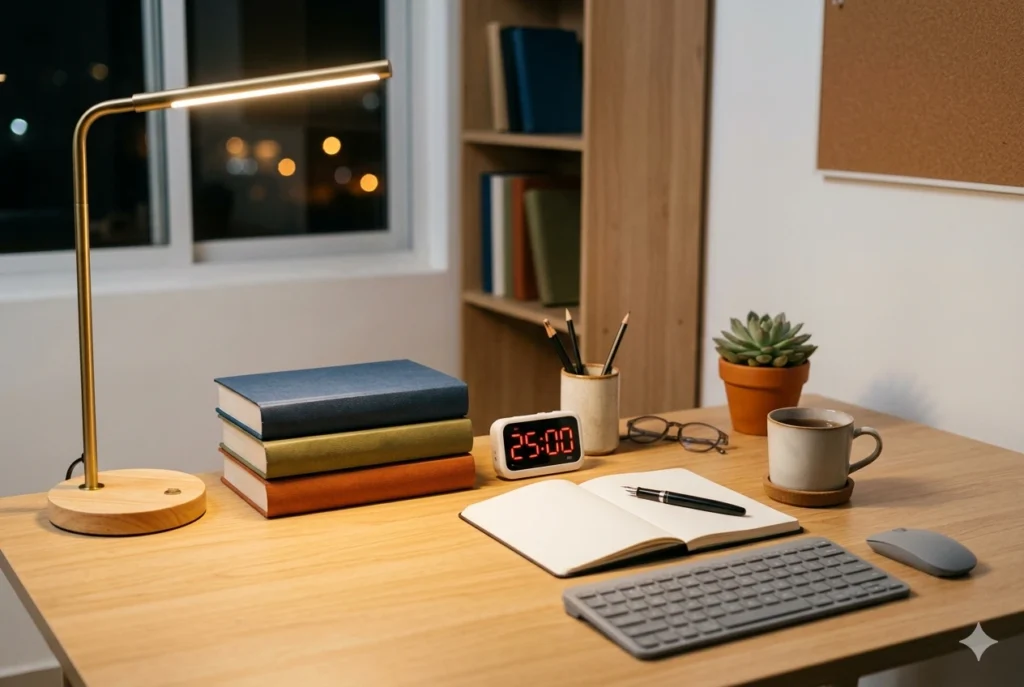
This is where the Pomodoro technique comes in — and it’s worth taking seriously.
A classroom-based study on productivity tools for college students describes the Pomodoro method as a system with documented benefits: it reduces interruptions, improves work quality, helps meet deadlines, and makes it easier to estimate how long tasks actually take.
The structure is simple:
• 25 minutes of focused work (one task, no switching)
• 5-minute break (stand up, stretch, get water — no phone)
• Repeat four times
• Then take a longer 20–30 minute break
If you’re trying to figure out how to focus for 2 hours straight, this is probably the most practical way to do it.
This is similar to how to stay focused while studying using structured sessions.
Step 4: Use Breaks to Reset, Not to Scroll
During your 5-minute breaks, stand up. Walk around. Get water. Look out a window.
Research on office workers trying to reduce sitting time found that some participants found standing offered a valued break from cognitively demanding tasks — and that changing posture helped them reset before returning to focused work.
The key rule: no phone during short breaks. Because once you open it, it’s very easy to lose track of time.
Step 5: Protect Your Sleep Like It’s Part of the Study Plan
Because it actually is.
Research shows that problematic smartphone use has an indirect effect on sleep quality — specifically through bedtime procrastination.
In simple terms: late-night scrolling → worse sleep → worse focus the next day.
Even a small change, like stopping phone use 30 minutes before bed, can help more than you expect.
Real Case Study: The Power Hour of Writing
Here’s a real, documented example of a structured focus system that works.
The Power Hour of Writing (PHOW) is an institution-led online writing community that was formally evaluated and published in a peer-reviewed academic journal.
The format is straightforward:
- 80 minutes total per session
- Structure: check-in → 60 minutes of focused work → follow-up discussion
- Participants are staff and postgraduate research students
The evaluation combined participant data with qualitative survey responses collected at three different time points.
Three consistent themes emerged across all surveys:
- The importance of community
- Making writing a legitimate part of daily work
- Accountability built directly into the session structure
What stands out here is simple: people didn’t need more time. They needed better structure. And that’s something anyone can apply.
This isn’t perfect every day. But it works more often than not.
Conclusion: Focus Longer by Making It Easier to Start
How to focus for long hours is not about pushing harder or trying to be perfect.
It’s about removing distractions, creating structure, and working with your brain instead of against it.
Here’s the short version:
- Remove the phone from the room
- Define one clear outcome per session
- Use 25-minute focus blocks
- Take real breaks
- Protect your sleep
Do this consistently for a few days.
You’ll start noticing a difference—not just in how long you sit, but in how much you actually get done.
And that’s what really matters.






Very good and it’s help me👍